
Wednesday, May 21, 2025

Friday, April 18, 2025
Color - Reflection, Refraction, Absorption
An OBJECT is given a color name based on what color it GETS TO YOU. You can only see when light reaches your eyes. If light doesn't reach your eyes, you see "darkness". Therefore, if you see a box and call it Red, it's because red light reflected off the object and came to your eyes.
FILTERS are named after what color is allows to go through. A Blue filter is called Blue because when it is put in front of a white light, Blue shines on the wall behind it. If you shine a Red light on a Blue filter, it will ABSORB all the red light allowing no light to pass.
When light is absorbed, it turns into heat. Darker colors absorb more, lighter colors reflect more.


Wednesday, April 16, 2025
Color Theory

White light is when your brain sees all the colors together (this is why a white flashlight's light can be spread out into a rainbow). Black is when we are not receiving light energy. Grey is when there is an equal distribution of colors, but they're not at their fullest (25%, 25%, 25% or all the colors).
When looking at DIGITAL sources - you're receiving only RGB input. Your brain can then tell you any color based on what is mixed. If you look at a source in REAL LIFE, you could be seeing light with a wavelength of yellow light (most likely) or a mixture of colors (R, G, and Y). This is because your brain cannot distinguish between an even mix of R+G or just pure Y light.
Monday, April 14, 2025


Friday, March 28, 2025
Constructive and Deconstructive Interference
Constructive Interference is when waves ADD or BUILD. The waves are on the SAME SIDE.

Deconstructive Interference is when waves SUBTRACT or CANCEL each other (temporarily until they're no longer overlapping). The waves are on OPPOSITE SIDES.

You can also have interference with standing waves. Look to see how they're "in sync" or "out of sync" and how that makes them add to be bigger or cancel to be smaller.
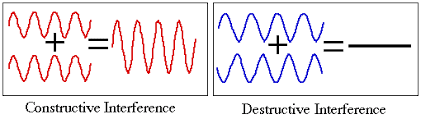
Examples:
A (+2) + (+3) wave = +5 wave
A (-2) + (+3) wave = +1 wave
 .
. 
Wednesday, March 26, 2025
Sound Waves
Image of a sound wave traveling through particles.

Sound is when something vibrates and starts to move a medium through compressions. The energy is carried by the particles in the medium. They bump into each other (this is where the compression is) and then bounce back to roughly their starting position. Notice: this is a description of longitudinal.
The ENERGY transfers or is passed along from particle to particle. The particles themselves just move left and right a short ways. Particles don't move across the room.
Monday, March 24, 2025
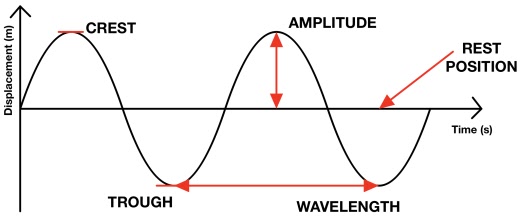
Labeled Waves
Waves are a way in which energy is transferred. You can see the energy moving forward. The difference between transverse and longitudinal is the direction the medium travels in relation to the energy.

What are the parts of the wave???
Know these terms:
- Compression
- Crest
- Amplitude
- Wavelength
- Rest position/equilibrium

Monday, March 10, 2025
Calculating Cost of Electricity

If you'd like to know the cost you follow this formula:
$ = $/kWh * kW *h
OR
$ = $/kWh * kWh
Notice, since the price is given as an amount per 1 kWh, you need to find the total amount of kWhrs then multiply the price by your kWh.

Monday, February 17, 2025

Friday, January 24, 2025

Subscribe to:
Posts (Atom)